
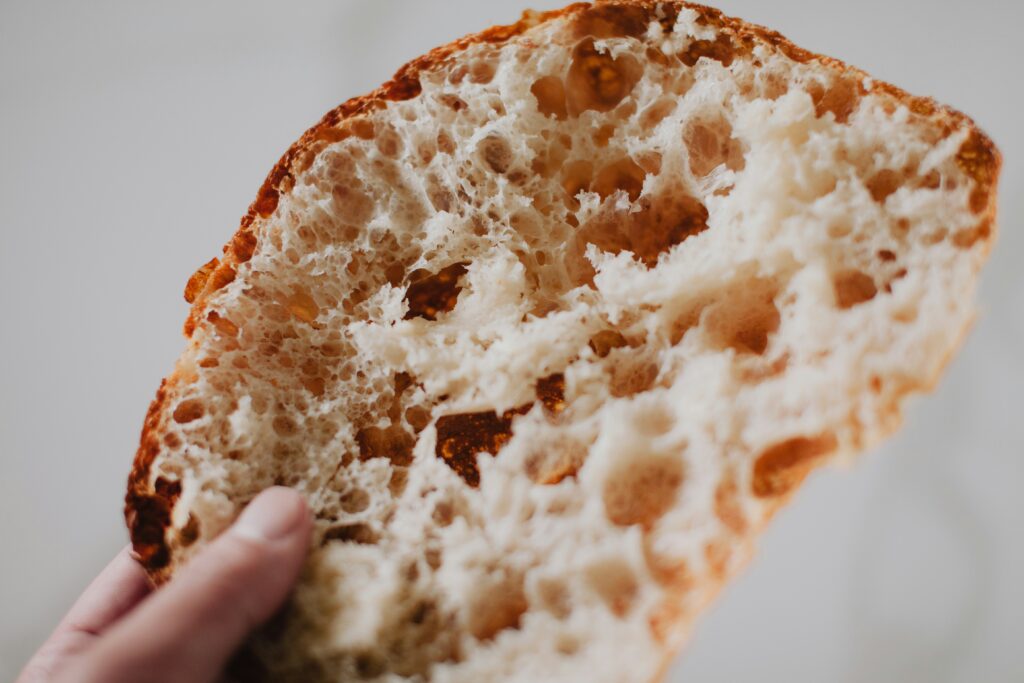
I’ve started experimenting with making bread from yeast, , and I’m realizing that there really isn’t a single “correct” way. There are just methods to get the result you want.
Right now, I’m following the recipe from Artisan Bread in Five Minutes a Day, which is incredibly reliable and honestly hard to mess up.
So far, I’ve tried a few variations:
- Curcuma and pepper: Fail. I couldn’t taste the spices. The curcuma gave a nice yellow color.
- Seeds: Nice result. The seeds actually make the dough easier to work with.
- Olives: Somewhat fail. The olives were cut too big, and I didn’t know they had to be patted dry, so they didn’t stick to the dough properly.
Some other things I’ve noticed:
Some other observations:
- I can’t do the scoring (cutting the top layer) well. But it’s not easy with yeast bread, sourdough should be easier.
- Switching from a standard flour to one with higher protein content helped with stickiness and overall handling.
Hydration
I don’t fully understand how hydration works yet. I know there are different percentages and that higher hydration is supposed to be better if you want a more open-crumb. The downside is that higher hydration makes the dough much harder to handle because it becomes very sticky. I’ve also learned that flour with higher protein content absorbs water better, which makes higher hydration more achievable. Further experiments needed.
Proofing
I’ve also heard about proofing, including under-proofing and over-proofing, and how timing affects the final bread. At the moment, I mostly follow the recipe and go by intuition. This is another area I know exists but don’t fully understand yet.
Kneading
I don’t know what I’m doing, but the bread turns out fine anyway.
Steam and oven setup
My oven doesn’t have a broiler function, so I’ve been DIY-ing it. I bake the bread on an upside-down oven tray, and place a metal pan on the bottom of the oven. Everything gets preheated to 230°C, and right after putting the bread in, I pour a cup of water into the bottom bowl. It immediately fizzles and creates steam, which is much needed in the first few seconds of baking bread. The first time it felt like a dangerous science experiment, because the steam forms instantly and the oven is extremely hot. It worked well, but you really have to be careful when opening the oven door.
Overall, I’m enjoying the experimentation and my current goal is understanding how different things change the bread. So far, the core of what I learned is that there’s no one way to make bread. I’ll keep experimenting some more before moving on to sourdough.